



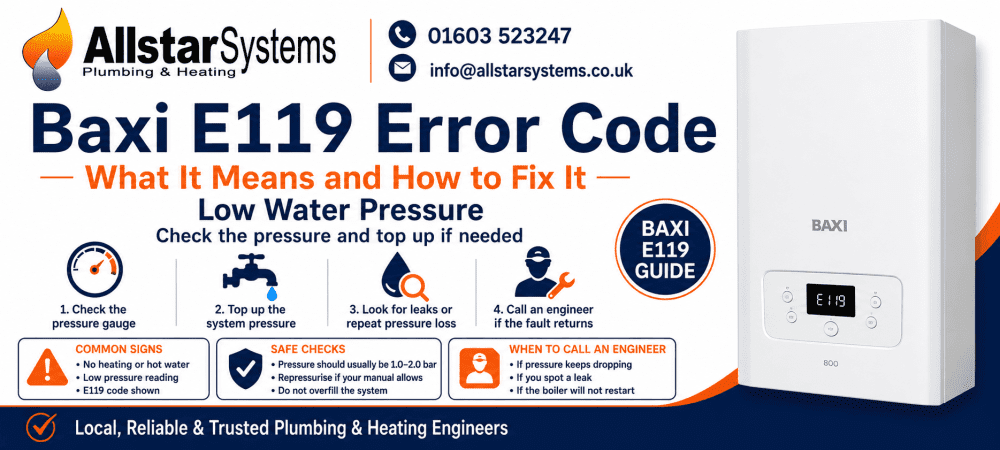
Baxi E119 Error: Why the Gauge Drops and What To Do Next
A Baxi E119 error often appears when the heating circuit has lost too much water.
On many Baxi models, this message links to a low system reading. The usual working range often sits around 1.0 to 2.0 bar, although your own manual should guide you first.
This issue can be simple after radiator bleeding. However, repeated drops can point to a leak, valve issue, expansion vessel problem, or sensor fault.
What does E119 mean?
E119 tells you the appliance has detected that the water level is too low for normal use.
Your heating circuit needs enough water to carry heat through pipes and radiators. If the gauge falls too far, the appliance may stop.
In freezing weather, check your model guide carefully. Some Baxi warnings can also link to frozen condensate pipework.
Why does this warning appear?
Radiators were recently bled
Bleeding lets trapped air escape. However, it can also reduce the reading on the gauge.
So, after bleeding several radiators, you may need to refill the system slightly.
Small leak in the system
A slow leak can lower the reading over days or weeks.
Look around radiator valves, towel rails, visible pipework, and beneath the appliance. Rust marks, staining, or damp flooring can all give clues.
Pressure relief valve problem
The relief valve protects the system if the reading climbs too high.
If that valve fails to seal, water can leave through the discharge pipe. An engineer should inspect this.
Expansion vessel issue
The expansion vessel helps absorb water movement as the system heats and cools.
If it loses charge or fails, the gauge can move too much. As a result, the appliance may lock out again.
Natural loss over time
A rare top-up is not always unusual. However, frequent refilling is a warning sign.
If the gauge drops again and again, find the cause before adding more water.
Safe checks before booking a repair
First, check the gauge when the system is cold. Compare the reading with your Baxi manual.
Next, look for visible leaks. Check radiator valves, pipe joints, floors, skirting boards, and the area below the appliance.
Then, think about recent radiator bleeding. If you removed air, the system may need a careful top-up.
After that, use the filling loop only if your manual explains how. Add water slowly while watching the gauge.
Stop at the correct range for your model.
Finally, try one reset if your manual allows it. If E119 returns, stop resetting the appliance.
What should you avoid?
Do not remove the case.
Inside, there are gas parts, electrical components, sealed areas, and hot surfaces.
Do not keep topping up every few days. This can hide a leak, failed valve, or expansion vessel fault.
Also, do not overfill the system. Too much water can create other problems.
Can you fix E119 yourself?
Sometimes, yes.
If the gauge is low and your manual explains the filling loop, you may be able to restore the correct reading.
You may also need a small top-up after bleeding radiators.
However, if the warning returns, stop there. The cause may involve a leak, valve fault, expansion vessel issue, sensor problem, or internal part.
When should you call an engineer?
Call an engineer if E119 returns after topping up and one reset.
Also, book help if the gauge keeps falling, the discharge pipe drips, or damp marks appear.
You should arrange support if the appliance still shows E119 after refilling.
Likewise, get help if you are unsure about the filling loop.
A Gas Safe registered engineer can check leaks, the relief valve, the expansion vessel, sensor readings, and internal parts safely.
Why proper diagnosis matters
E119 can look like a simple refill issue. However, the cause matters.
If a leak exists, adding water will not solve it. If the expansion vessel has failed, the warning can return.
Proper diagnosis helps stop repeated lockouts. It also protects the appliance from extra strain.
Can servicing reduce future E119 issues?
Annual servicing cannot prevent every issue. However, it can help spot leaks, unstable readings, worn parts, and unsafe operation early.
During a service, an engineer checks how the appliance starts, runs, and shuts down.
Between services, check the gauge now and again. Also, act early if readings drop, radiators gurgle, or damp marks appear.
Does E119 mean replacement is needed?
Not usually. E119 often relates to a repairable issue.
The cause may be recent radiator bleeding, a small leak, relief valve trouble, expansion vessel failure, or gradual water loss.
However, replacement may be worth discussing if the appliance is old, unreliable, or costly to maintain.
Need help with a Baxi E119 error?
A Baxi E119 error usually means the heating circuit reading has dropped too low.
Start with safe checks only. Check the gauge, review your manual, look for visible leaks, top up only if needed, and try one approved reset.
Then, if the warning returns, arrange a visit from a Gas Safe registered engineer.
Need reliable heating diagnostics, servicing, or repairs? Contact us today for expert support.
Baxi E119 Error Code FAQs
What does E119 mean on a Baxi boiler?
On many Baxi models, E119 means the boiler’s primary water pressure has fallen too low. Older manuals place that lockout below 0.5 bar
What pressure should a Baxi boiler be?
Baxi says normal operating pressure is usually between 1.0 and 2.0 bar. Also, many boilers need topping up once pressure drops below 1.0 bar.
Can I fix a Baxi E119 error myself?
Yes, often you can. First, check the gauge. Then, re-pressurise the system if pressure is low. However, recurring faults need professional diagnosis.
Why does my Baxi boiler keep losing pressure?
Common causes include air in the system, leaks, PRV issues, and expansion vessel faults. Baxi says frequent pressure drops should be checked by an engineer.
Could E119 mean something else?
Possibly. A current Baxi help page also links E119, on some models and situations, to a frozen condensate pipe. So, always check your exact model manual.
Is Baxi E119 a low pressure fault?
Yes, Baxi E119 is commonly linked to low boiler pressure. If the pressure drops too far, the boiler may stop working to protect itself.
How do I top up pressure on a Baxi boiler?
Check your Baxi manual for the correct filling loop or filling link method. Then, slowly top up the system until the pressure reaches the recommended range. Close the valves fully afterwards.
Can a frozen condensate pipe cause Baxi E119?
Yes. Baxi says E119 may show when the condensate pipe is frozen, alongside codes such as E28, E53, E133, and E128. This often happens during freezing weather.
Can bleeding radiators cause Baxi E119?
Yes, bleeding radiators can lower system pressure. Therefore, check the boiler pressure afterwards and top it up if your manual advises it.
Can sludge cause a Baxi E119 fault?
Sludge does not usually cause low pressure directly. However, Baxi says debris can affect the pressure relief valve, and dirty system water can create other heating problems.