



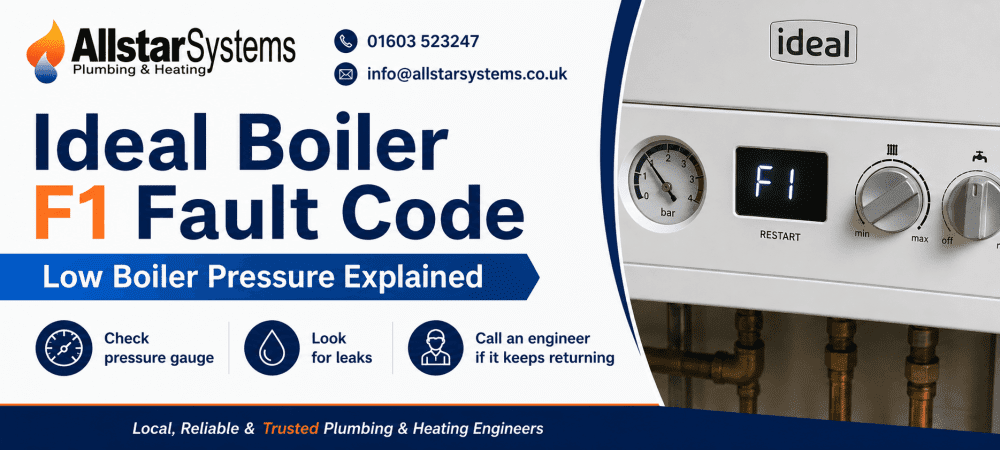
Ideal Boiler F1 Fault Code: Causes, Fixes and Safe Checks
If your Ideal appliance shows F1, it usually means the sealed heating circuit has dropped below its normal working range.
When this happens, the appliance may lock out. As a result, radiators could stay cold, and taps may stop delivering reliable warmth.
Sometimes, the cause is simple. For example, radiators may have been bled recently. In other cases, a leak, faulty valve or expansion vessel issue may sit behind the warning.
This guide explains what F1 means, what you can check safely, and when expert help makes sense.
What Does F1 Mean on an Ideal Appliance?
On many Ideal Logic, Logic Max and Logic+ models, F1 points to low circuit charge.
Your heating setup needs enough charge to move heated fluid around the home. If the level drops too far, the appliance stops to protect itself.
Many sealed heating setups sit around 1 to 1.5 bar when cold. However, your own manual should always guide you.
If you feel confident and the filling instructions are clear, you might restore the level yourself. However, if F1 returns, arrange a professional visit.
Which Ideal Models Show This Code?
The F1 warning appears on many Ideal Logic and Logic Max appliances. It can also show on some related ranges.
Models may include:
- Ideal Logic combi units
- Ideal Logic system units
- Ideal Logic Max ranges
- Ideal Logic+ models
- some Ideal Code appliances
Because model details vary, check the user guide. Alternatively, give the model name and display code to a qualified engineer.
Why This Warning Matters
F1 matters because the appliance cannot operate correctly without enough charge in the heating circuit.
If the level sits too low, heat cannot travel through radiators as it should. The appliance may then stop working until the cause is corrected.
A single drop after radiator bleeding may prove minor. Yet repeated drops usually point to an underlying fault.
Common reasons include small leaks, a relief valve issue, trapped air, poor water quality or expansion vessel failure.
Safe Checks Before Booking a Repair
You can carry out a few simple visual checks first.
Look at the gauge or digital display. Then check whether F1 appears on screen. Also, think about any recent radiator bleeding or heating work.
Next, look around visible pipework, radiator valves and the appliance area. Watch for damp patches, stains, drips or green marks on copper.
Do not remove the casing. Also, do not touch sealed, gas, oil, combustion or internal parts.
If anything seems unsafe, stop and call a qualified heating engineer.
Should You Top It Up Yourself?
Some homeowners can top up an Ideal appliance safely. This depends on the model, filling loop and manual instructions.
The usual process lets mains water enter the sealed circuit until the gauge reaches the correct range. Then both filling valves must close fully.
Do not continue if the instructions feel unclear. Also, avoid using a damaged filling loop or adding too much.
If F1 keeps returning, repeated top-ups are not a fix. They only mask the cause.
Why the Level Keeps Dropping
A falling gauge reading usually means fluid has left the sealed circuit or a component has stopped doing its job.
Common causes include:
- recent radiator bleeding
- leaking radiator valves
- drips from pipe joints
- hidden pipe leaks
- relief valve discharge
- expansion vessel faults
- trapped air
- faulty sensor readings
- corroded pipework
- dirty heating fluid
- recent repair work
One top-up after bleeding may solve the issue. However, regular loss needs investigation.
After Bleeding Radiators
Bleeding radiators releases trapped air. This often improves rooms with cold spots or noisy panels.
However, when air leaves the circuit, the gauge reading can fall. If it falls too far, the Ideal display may show F1.
In this case, a careful top-up may clear the warning. Yet constant radiator bleeding suggests a deeper issue.
Leaks Around Radiators or Pipework
Leaks remain one of the most common causes of repeat F1 warnings.
Check radiator valves, towel rails, pipe joints, visible boiler connections and pipework near floors. Even a small weep can lower the gauge over time.
Look for damp marks, flaking paint, green staining or water beneath fittings.
If you find a leak, book a repair. Repeatedly topping up the circuit will not solve it.
When the Gauge Rises Too Far
Sometimes the gauge rises too high after topping up. This may happen when too much water enters the circuit.
It may also happen if the filling valves stay partly open. In other cases, a separate component fault may affect the reading.
If the gauge climbs into a high range, stop using the filling loop. Check your manual and seek advice if it keeps happening.
If F1 Comes Back Again
A returning F1 code means the cause remains unresolved.
The fault may relate to a hidden leak, failed expansion vessel, relief valve discharge, sensor issue or corrosion inside the pipework.
At this point, a heating engineer should test the setup. They can find the cause and explain the safest repair route.
Poor Water Quality and Sludge
Sludge does not usually trigger F1 by itself. However, dirty heating fluid can damage the wider setup over time.
Corrosion may affect valves, pumps, radiators and pipework. It may also increase the chance of small leaks.
Signs of poor water quality include cold radiator patches, noisy circulation, dark radiator fluid and repeated circulation faults.
An engineer may recommend inhibitor treatment, filter checks or cleaning where suitable.
When to Call an Engineer
Call a qualified engineer if the warning returns, the gauge keeps falling or you see water where it should not be.
You should also get help if:
- the appliance will not reset
- the filling loop looks damaged
- the gauge rises too high
- radiators need bleeding often
- pipework looks corroded
- unusual noises appear
- a hidden leak seems possible
- you feel unsure about the display
A proper diagnosis can prevent repeat faults and unnecessary part changes.
What You Should Avoid
Do not ignore repeat F1 warnings.
Also, avoid removing the casing, touching internal parts or leaving the filling loop open.
Do not keep topping up every few days. Also, do not reset the appliance again and again without finding the cause.
Most importantly, never attempt gas or combustion work yourself.
Does F1 Mean You Need a New Appliance?
Usually, no.
F1 often relates to a low circuit charge rather than a failed appliance. Many causes are repairable, including leaks, faulty valves, expansion vessel issues and relief valve problems.
Replacement may only deserve thought if the unit is old, unreliable or costly to repair.
Even then, get a clear diagnosis first. This helps avoid replacing a working appliance for a fault elsewhere in the heating setup.
Need Help With an Ideal F1 Warning?
If your Ideal display shows F1, check the gauge and read the manual first. Only top up the circuit if you understand the steps and feel safe doing so.
If the warning returns, stop adding water. A qualified heating engineer can inspect the appliance, radiators, pipework and related parts.
This gives you a safer answer and a clearer repair plan.
FAQs About the Ideal Boiler F1 Fault Code
What does F1 mean on an Ideal boiler?
F1 usually means low water pressure. The boiler may stop working until the system pressure returns to the correct range.
What pressure should an Ideal boiler be?
Many Ideal boilers should sit around 1 to 1.5 bar when cold. However, always check the manual for your exact model.
Can I fix an Ideal F1 fault myself?
You may be able to repressurise the boiler if the manual gives clear instructions and the filling loop is accessible. If unsure, call an engineer.
Why does my Ideal boiler keep showing F1?
The system may keep losing pressure because of a leak, faulty valve, expansion vessel issue, pressure sensor fault or wider heating system problem.
Is an Ideal F1 fault dangerous?
The F1 fault itself usually relates to low pressure. However, you should not ignore leaks, repeated faults, unusual noises or unsafe appliance signs.
Can bleeding radiators cause an F1 fault?
Yes. Bleeding radiators releases air and can lower system pressure. The boiler may show F1 if pressure drops too far.
Should I keep topping up my Ideal boiler?
No. If pressure keeps dropping, there is likely a problem that needs investigation.
Can a leak cause the Ideal F1 fault?
Yes. A leak in radiators, valves, pipework or boiler components can cause repeated pressure loss and trigger the F1 fault.
Does the F1 fault mean my Ideal boiler is broken?
Not always. The boiler may simply have low system pressure. However, repeated pressure loss needs checking.
When should I call an engineer for an Ideal F1 fault?
Call an engineer if the F1 fault returns, pressure keeps dropping, you see leaks, the pressure rises too high, or you cannot repressurise safely.