

Worcester Bosch E2 Fault Code: Flow Sensor Meaning, Causes and Safe Repair Advice
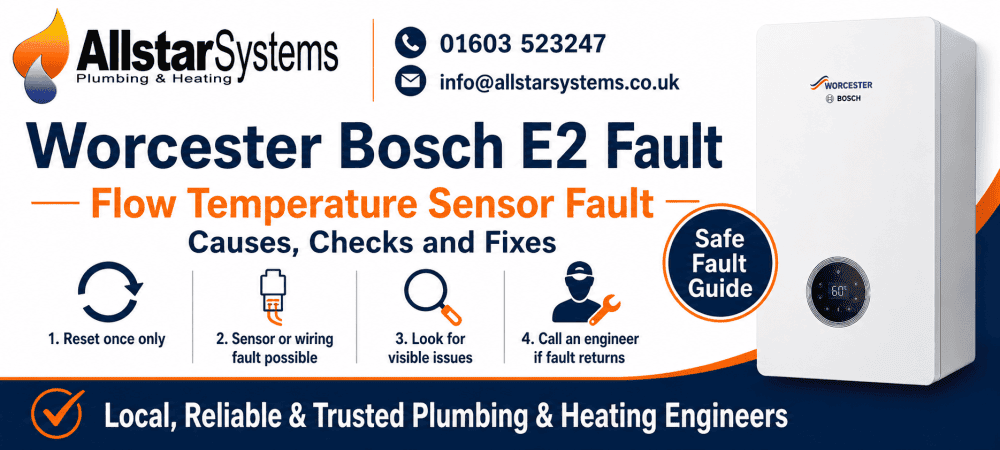
A Worcester Bosch E2 fault code usually points to a central heating flow sensor problem. On many Greenstar models, it means the CH flow NTC sensor has given a poor or failed reading.
This part monitors the temperature of water leaving the appliance. The control board then uses that reading to manage heat output.
If the reading becomes unreliable, the boiler may stop working. As a result, you could lose heating, hot water, or both.
What Does Worcester Bosch E2 Mean?
Worcester Bosch E2 normally means the boiler cannot trust the flow temperature signal.
The flow sensor checks how warm the water is as it leaves the heat exchanger. If the signal is missing, unstable, or outside range, the appliance may lock out.
This protects the system from unsafe operation. However, if the warning returns after one reset, the cause needs proper diagnosis.
What Is a Flow Sensor?
A flow sensor, often called an NTC sensor, is a temperature-reading part inside the appliance.
NTC stands for negative temperature coefficient. In simple terms, its electrical resistance changes as temperature rises or falls.
The boiler reads this signal and adjusts operation. Therefore, a poor reading c affect heating performance, safety, and reliability.
Why a Faulty Sensor Stops the Boiler
The boiler needs accurate temperature information before it could run safely.
If the flow reading fails, the appliance cannot judge how hot the water is. It may then stop to avoid overheating or poor control.
This does not always mean the sensor itself has failed. The issue may involve the connector, wiring, moisture, circulation, or PCB.
Is E2 the Same on Every Worcester Bosch Model?
No, not always.
Many Greenstar models use E2 for a central heating flow NTC fault. However, some displays may show extra cause codes after the main warning.
For this reason, write down the full display message. This helps the engineer match the code to the exact model.
Common Signs of a Worcester Bosch E2 Fault
You may see E2 on the display. Heating and hot water may also stop.
The appliance may start briefly, then shut down. In some cases, radiators heat unevenly or fail to reach the set temperature.
You may also notice repeated cycling. However, these symptoms can overlap with other faults, so testing matters.
Common Causes of Worcester Bosch E2
Several issues can trigger this warning. Most relate to temperature sensing, wiring, moisture, circulation, or control readings.
Faulty flow sensor
The sensor can fail due to age, heat, or wear. If it sends the wrong reading, the boiler may lock out.
An engineer should test the part before replacing it.
Dirty or damaged connector
A dirty, loose, or damaged connector can interrupt the signal. This can make the appliance think the sensor has failed.
The connector sits inside the case, so it needs professional inspection.
Loose or broken wiring
The sensor signal travels through internal wiring. If a cable is loose, damaged, or broken, the signal may fail.
A qualified engineer can test the wiring before replacing parts.
Moisture inside the casing
Leaks, condensation, or damp marks can affect electrical parts. Moisture near the connector, sensor, or PCB can cause unreliable signals.
Do not open the boiler to check this yourself.
PCB or control board issue
The PCB reads the sensor signal. If the board misreads that signal, E2 may appear.
However, the sensor, connector, and wiring should be tested first.
Overheating or circulation problem
Poor circulation can cause the flow temperature to rise too quickly. This may happen due to trapped air, sludge, a weak pump, closed valves, or a blocked heat exchanger.
If circulation issues exist, the wider heating system may need cleaning or repair.
Age-related wear
Older appliances face more heat and electrical wear over time. Components, plugs, and wiring can become less reliable.
A proper diagnosis helps decide whether repair or replacement offers better value.
Safe Checks Before Calling an Engineer
You can make a few simple checks without opening the boiler.
First, write down the full code on the display. If extra numbers appear, note them too.
Next, check that the appliance has power. Make sure the fused spur, timer, programmer, thermostat, and room controls are set correctly.
Then, check the pressure gauge if your model has one. If it sits outside the range in your manual, follow the manufacturer’s guidance.
After that, try one reset if your Worcester Bosch manual allows it. If the warning clears and stays away, monitor the boiler.
However, if E2 returns, stop resetting it. Repeated resets will not repair a failed sensor, loose connector, damaged wiring, or PCB issue.
What to Avoid
Do not remove the boiler case. Do not touch sensors, wiring, gas parts, pumps, heat exchangers, PCB parts, or flue components.
Also, do not keep pressing reset. This may delay diagnosis and put extra strain on parts.
Do not assume the sensor is the only possible cause. Several faults can create the same warning.
When to Call a Gas Safe Engineer
Call an engineer if E2 returns after one reset. You should also book help if heating or hot water stops.
In addition, arrange support if the appliance starts and stops, cycles repeatedly, or shows extra cause codes.
A professional can test the sensor, connector, wiring, resistance values, PCB response, circulation, and system condition.
Can You Fix Worcester Bosch E2 Yourself?
No, not beyond safe external checks.
You can check power, controls, pressure, and try one approved reset. However, the flow sensor sits inside the casing.
Internal testing and replacement need a Gas Safe registered engineer.
Can E2 Damage the Boiler?
E2 is designed to protect the appliance. However, the underlying cause should still be fixed.
If poor circulation, overheating, moisture, or faulty wiring continues, further damage may occur.
Early diagnosis helps protect the boiler and restore reliable heating.
Will Servicing Prevent E2?
Annual servicing can reduce the risk of some faults. During a service, an engineer can inspect visible condition, check safe operation, and spot early concerns.
However, no service can guarantee that an electrical component will never fail.
Even so, regular servicing helps the appliance run safely and efficiently for longer.
Repair or Replace?
E2 does not usually mean you need a new boiler. In many cases, the issue can be repaired at lower cost than replacement.
However, age, reliability, part availability, repair cost, and efficiency all matter.
If your appliance is old or has several faults, replacement may be worth discussing. Even then, get a diagnosis first.
Why Choose Allstar Systems?
Allstar Systems provides Worcester Bosch fault diagnosis, boiler repairs, and heating support across Norwich and Norfolk.
Our engineers work with gas, oil, LPG, and electric heating systems. We give clear advice before repair work begins.
If your Worcester Bosch boiler keeps showing E2, our team can inspect the flow sensor, connector, wiring, controls, circulation, and wider heating system.
Final Advice on Worcester Bosch E2
Worcester Bosch E2 usually means the appliance has detected a central heating flow NTC sensor fault.
Start with safe checks only. Confirm the full code, check power, review controls, check pressure, and try one reset if your manual allows it.
If the warning returns, call a Gas Safe engineer. The cause may involve the sensor, connector, wiring, PCB, moisture, overheating, or circulation problems.
Worcester Bosch E2 Fault Code FAQs
What does the Worcester Bosch E2 fault code mean?
The Worcester Bosch E2 fault code usually means there is a flow temperature sensor fault. This sensor, also called a thermistor, monitors the temperature of water leaving the boiler. If it gives the wrong reading, the boiler may lock out for safety.
Why is my Worcester Bosch boiler showing an E2 code?
Your Worcester Bosch boiler may show an E2 code because the flow temperature sensor has failed or cannot read correctly. Common causes include a faulty thermistor, loose wiring, damaged connections, poor circulation, sludge, air in the system, or a control board fault.
What is a Worcester Bosch flow temperature sensor fault?
A Worcester Bosch flow temperature sensor fault means the boiler cannot trust the temperature reading from the flow pipe. Therefore, it may stop working to avoid overheating or unsafe operation. An engineer can test the sensor and related wiring.
Is the Worcester Bosch E2 code a thermistor fault?
Yes, the Worcester Bosch E2 error code often relates to the flow thermistor. The thermistor changes resistance as water temperature changes. If it fails, the boiler may think the water is too hot, too cold, or outside the safe range.
Can I fix a Worcester Bosch E2 fault myself?
You should not try to repair a Worcester Bosch E2 flow temperature sensor fault yourself. This fault involves internal boiler parts and electrical testing. However, you can check the boiler pressure and reset the boiler once if your manual allows it.
Can I reset my Worcester Bosch boiler with an E2 fault code?
You may reset the boiler once after basic safe checks. However, a reset will not fix a faulty sensor, damaged wiring, poor circulation, or PCB issue. If the Worcester Bosch E2 fault code returns, stop resetting the boiler and book a boiler repair.
Is a Worcester Bosch E2 fault dangerous?
A Worcester Bosch E2 fault is not always immediately dangerous. However, it can affect temperature control and boiler safety. Since the boiler may not read water temperature correctly, you should arrange a Gas Safe registered engineer if the fault stays on the display.
Will a Worcester Bosch E2 fault stop heating and hot water?
Yes, a Worcester Bosch E2 fault can stop both heating and hot water. The boiler may lock out because it cannot confirm safe flow temperature. As a result, your heating system may stay cold until the issue gets diagnosed and repaired.
Can poor circulation cause a Worcester Bosch E2 error code?
Yes, poor circulation can contribute to a Worcester Bosch E2 error code. If water cannot move through the boiler properly, temperature readings may rise quickly or behave abnormally. Sludge, airlocks, pump issues, or closed valves can all affect circulation.
Can sludge cause a Worcester Bosch flow temperature sensor fault?
Sludge can sometimes contribute to a Worcester Bosch boiler flow sensor fault. It can restrict water movement and affect heat transfer. In addition, debris may worsen circulation issues and place extra strain on sensors, pumps, and heat exchanger parts.
Can a faulty PCB cause a Worcester Bosch E2 fault?
Yes, a faulty PCB can cause a Worcester Bosch E2 fault if it misreads the sensor signal. However, the flow temperature sensor, wiring, or connectors may also be at fault. Therefore, an engineer should test the parts before replacing them.
Why does my Worcester Bosch E2 fault keep coming back?
A recurring Worcester Bosch E2 fault usually means the original sensor issue has not been fixed. The cause may involve a faulty thermistor, damaged wiring, poor circulation, sludge, overheating, or PCB failure. Repeated resets will not solve these faults safely.
Do I need a Gas Safe engineer for a Worcester Bosch E2 code?
Yes, you should call a Gas Safe registered engineer for a Worcester Bosch E2 code. The engineer can test the flow temperature sensor, wiring, PCB, pump, and circulation. This gives you a safe diagnosis and avoids replacing the wrong part.
How much does it cost to fix a Worcester Bosch E2 fault?
The cost to fix a Worcester Bosch E2 fault depends on the cause. A replacement sensor may cost less than fixing a wiring issue, PCB fault, or circulation problem. Therefore, a proper boiler fault diagnosis gives the clearest repair price.
How can I prevent Worcester Bosch E2 fault codes?
Regular boiler servicing can reduce the risk of Worcester Bosch E2 fault codes. During a service, an engineer can check temperature readings, inspect wiring, review circulation, and spot early signs of wear. In addition, clean system water helps protect boiler components.