



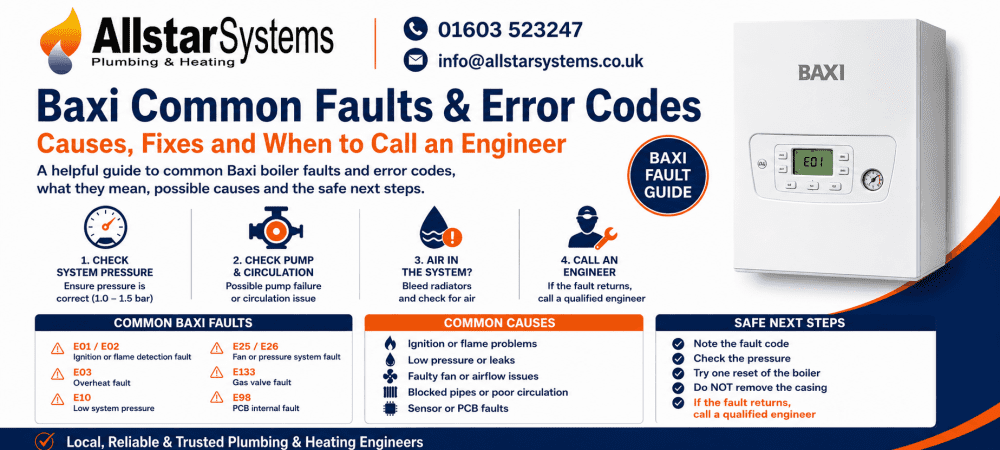
Baxi Boiler Display Codes: What They Mean and What To Check Safely
When a Baxi appliance stops, the screen can give a useful clue. The message might relate to water level, circulation, flame loss, start-up failure, fan operation, sensor readings, or frozen condensate pipework.
However, Baxi ranges do not all use identical codes. Therefore, check your own manual before deciding what the message means.
Some problems allow safe external checks. Yet, anything linked to gas, combustion, fans, pumps, wiring, or sealed parts needs a Gas Safe registered engineer.
How to understand a Baxi display message
A display message helps narrow the search. It does not prove which part has failed.
For example, one warning might suggest low water level. Another might point towards weak circulation, flame loss, or a fan problem.
So, treat the screen as a guide. Then, follow your manual and avoid internal DIY work.
Key Baxi warnings explained
E118 and E119 often appear when system pressure has dropped.
Many Baxi models run between 1.0 and 2.0 bar. If the gauge sits below 1.0 bar, your manual may explain how to top it up.
However, repeated drops need attention. The cause could be a small leak, expansion vessel issue, pressure relief valve problem, or faulty sensor.
E125 usually points towards poor circulation.
Trapped air, a weak pump, blocked pipework, sludge, or a restricted heat exchanger can all reduce movement.
If radiators warm unevenly, make noise, or stay cold in places, the system needs a proper check.
E128 can appear when the unit loses flame too often.
During freezing weather, the cause might be an iced condensate pipe. In milder conditions, the issue could involve fuel supply, flame sensing, ignition parts, or combustion.
If E128 returns, stop resetting the appliance.
E133: Start-up or supply problem
E133 often appears when the unit cannot light or prove flame.
First, check whether other gas appliances work. Also, check prepayment credit if you use a meter.
In winter, inspect any outside condensate pipe for ice. Frozen drainage can stop normal start-up.
If these steps do not help, book an engineer.
E160 points towards fan operation.
The fan helps remove combustion gases safely. If it slows, fails, or sends a poor signal, the unit may stop.
This is not a homeowner repair. The part sits inside the appliance and needs safe testing.
E78 can relate to the pressure sensor on models that use this code.
This sensor helps the appliance read water level inside the heating circuit. If it gives poor readings or loses connection, the display may show E78.
This can look like a low-pressure problem. However, topping up will not solve it if the sensor or wiring has failed.
Why Baxi warnings happen
Most Baxi warnings fall into a few groups.
Water-level problems often come from leaks, radiator bleeding, expansion vessel faults, or sensor issues.
Circulation problems can involve trapped air, sludge, pump wear, closed valves, or blocked pipework.
Start-up and flame warnings might involve fuel supply, frozen condensate pipework, electrodes, flame sensing, or combustion.
Fan and electrical warnings can involve internal components, wiring, plugs, or control boards.
Safe checks before booking a repair
First, write down the exact message on the display. Also, note when it appears, such as during start-up, heating demand, or hot water use.
Next, check the gauge if the message relates to water level. Compare the reading with your Baxi manual.
Then, consider the weather. If temperatures sit below freezing, check any outside condensate pipe for ice.
After that, try one reset if your manual allows it. Stop if the same warning returns.
You can also check your timer and thermostat. Make sure they are asking for heat.
Finally, look for external clues. Damp patches, cold radiators, strange noises, or visible ice can help your engineer find the cause faster.
What should you avoid?
Do not remove the outer case.
Inside, there are gas parts, electrical components, sealed chambers, fans, electrodes, and combustion areas.
Also, do not test the gas valve, fan, pump, PCB, wiring, electrodes, or pressure sensor yourself.
Do not keep pressing reset. Repeated resets can hide a safety issue and delay the right repair.
Can you fix a Baxi warning yourself?
Sometimes, but only in a limited way.
You may be able to top up low water level if your manual explains the filling process. Also, you may be able to thaw an outside condensate pipe safely by following manufacturer guidance.
However, if the display returns after one reset, stop there.
Warnings linked to fans, gas supply, ignition, flame detection, pumps, PCBs, sensors, or wiring need professional diagnosis.
When should you call an engineer?
Call an engineer if the same display message returns after one reset.
Also, book help if the gauge keeps dropping, the appliance locks out repeatedly, or heating and hot water both stop.
You should arrange support for E125, E160, repeated E128, repeated E133, or any problem involving gas, combustion, fan operation, pumps, wiring, or internal sensors.
A Gas Safe registered engineer can test the appliance safely and confirm the correct repair.
Can servicing reduce future Baxi problems?
Annual servicing cannot prevent every breakdown. However, it can help spot early signs of wear, poor combustion, falling pressure, weak ignition, fan issues, and poor circulation.
During a service, an engineer checks safety performance and how well the appliance starts, runs, and shuts down.
Also, act early if you notice repeated lockouts, falling gauge readings, slow heating, noisy radiators, or unreliable hot water.
Does a warning mean replacement is needed?
Not usually. Many Baxi warnings relate to repairable parts or system conditions.
However, replacement may become worth discussing if the appliance is old, inefficient, unreliable, or costly to maintain.
A good engineer should explain the repair options clearly. Then, you can compare repair cost with long-term value.
Need help with Baxi display codes?
Baxi display codes can relate to water level, circulation, flame loss, start-up problems, fan operation, frozen condensate pipework, sensors, wiring, or internal parts.
Start with safe external checks only. Note the message, check the gauge where relevant, consider freezing weather, review controls, and try one approved reset.
Then, if the warning returns, arrange a visit from a Gas Safe registered engineer.
Need reliable heating diagnostics, servicing, or repairs? Contact us today for expert support.
Baxi Common Faults and Error Codes FAQs
What do Baxi boiler error codes mean?
Baxi boiler error codes are display messages that help identify why your boiler has stopped working. They can relate to low pressure, overheating, poor circulation, gas supply issues, flame loss, fan faults, sensor faults, or condensate pipe problems.
What are the most common Baxi boiler fault codes?
Common Baxi boiler fault codes include E110, E118, E119, E125, E128, E130, E133, E154, E160, and E270. However, fault meanings can vary by Baxi model, so always check your boiler manual.
What does Baxi E110 mean?
Baxi E110 can mean the boiler maximum temperature has been exceeded, or the safety thermostat sensor has tripped. Baxi also notes this can happen where there is a probable jammed pump or air in the circuit.
What causes a Baxi E110 fault?
Common causes include trapped air, poor water circulation, a stuck pump, low pressure, sludge, closed radiator valves, or a blocked heat exchanger. Because E110 relates to overheating, repeated faults need professional attention.
What does Baxi E118 mean?
Baxi E118 means the boiler water pressure is low, usually below 0.5 bar. Low pressure can stop the boiler from operating safely.
Is Baxi E119 the same as low pressure?
On many Baxi boilers, E119 relates to low water pressure or a water pressure switch issue. If your boiler shows E119, check your pressure gauge and follow your Baxi manual before topping up.
What pressure should a Baxi boiler be?
Most sealed central heating systems usually work around 1 to 1.5 bar when cold. However, always follow your exact Baxi boiler manual because pressure guidance can vary by model.
What does Baxi E125 mean?
Baxi E125 means water circulation fault. This means the boiler has detected poor water movement through the heating system.
What causes a Baxi E125 circulation fault?
Common causes include trapped air, a faulty pump, closed valves, sludge, blocked pipework, low pressure, or a restricted heat exchanger. Therefore, E125 often needs a heating engineer if it returns after safe checks.
What does Baxi E128 mean?
Baxi E128 means a safety error for frequent loss of flame. This means the boiler has lost flame repeatedly and has stopped for safety.