



Worcester Bosch Error Codes: A Plain-English Homeowner Guide
When a Worcester Bosch boiler shows a warning on its display, it means the appliance has found something unusual.
That warning helps narrow the issue. However, it does not always confirm the failed part. For example, ignition trouble could come from the fuel supply, condensate drainage, flame sensing, wiring, or a control-board issue.
So, use the display message as a guide, not a full diagnosis. If the same warning returns, arrange a qualified inspection.
Why Display Warnings Matter
Modern boilers monitor many parts while they run.
They check flame detection, temperature, pressure, airflow, pumps, drainage, and safety limits. If one reading falls outside the expected range, the unit may stop.
This lockout protects the home. It also gives the engineer a useful starting point.
Before booking a repair, write down the exact letters and numbers shown. Extra digits can matter on some models.
Common Worcester Bosch Warnings
EA usually means the burner has not proved a flame.
Possible causes include an interrupted fuel supply, frozen condensate pipe, ignition issue, flame-sensing fault, or internal control problem.
If other gas appliances have stopped too, the property supply may be the cause. However, if you smell gas, leave the building and call 0800 111 999.
A1: Pump or Circulation Problem
A1 often points to poor circulation.
You may notice cold radiators, gurgling sounds, or weak heat around the home.
The issue may involve the pump, low pressure, trapped air, or a blocked part of the heating circuit. If simple external checks do not help, book an engineer.
CE usually means the sealed heating circuit needs attention.
Many systems sit around 1 to 1.5 bar when cold. Even so, your manual should guide you.
If the gauge is low, follow the manufacturer’s filling instructions. If the pressure drops again, stop topping up. Repeated loss often means a leak or another system issue.
C6 suggests the fan is not running at the expected speed.
The fan helps move combustion gases through the flue. Therefore, this warning has a safety link.
Do not open the case. A Gas Safe registered engineer should check the fan, flue route, wiring, and control parts.
C7 means the fan has not started.
The boiler may stop before firing. This prevents unsafe operation.
Fan-related issues need professional testing. Homeowners should only check external items and follow the user manual.
E2: Flow Temperature Sensor Issue
E2 can point to the central heating flow sensor.
This part reads the temperature of water leaving the boiler. If the reading fails, the appliance may stop or run poorly.
Possible causes include sensor failure, loose wiring, poor connection, moisture, or PCB trouble.
E9: Safety Temperature Limit Reached
E9 usually means the unit has become too hot.
Common causes include low pressure, trapped air, weak circulation, sludge, closed valves, pump problems, or a blocked heat exchanger.
Do not keep resetting the boiler. Overheating warnings need careful investigation.

D5 or d5: Condensate Pump Problem
D5 can relate to condensate drainage on some models.
The condensate pump removes acidic water produced during normal operation. If that drainage route fails, the boiler may stop.
Possible causes include a faulty pump, blocked pipe, float switch issue, wiring problem, or frozen external pipework.
F0 can mean an internal control issue on some Greenstar models.
It may involve electrical connections, communication problems, or the PCB.
Try one reset only if the manual allows it. If F0 returns, book a professional visit.
F7 means the appliance senses flame activity when it should not.
This is not a DIY repair. Possible causes include flame sensor faults, moisture, wiring problems, PCB issues, or combustion-related faults.
Call a Gas Safe registered engineer.
FA: Flame Detected After Shut-Off
FA means flame detection continues after the gas valve should have closed.
This warning needs prompt attention. It may involve the flame sensor, gas valve, wiring, or control system.
Do not keep resetting the boiler if FA appears.
Fd often means someone has pressed the reset button accidentally.
Follow the manual for your model. If another warning appears afterwards, write it down before pressing anything again.
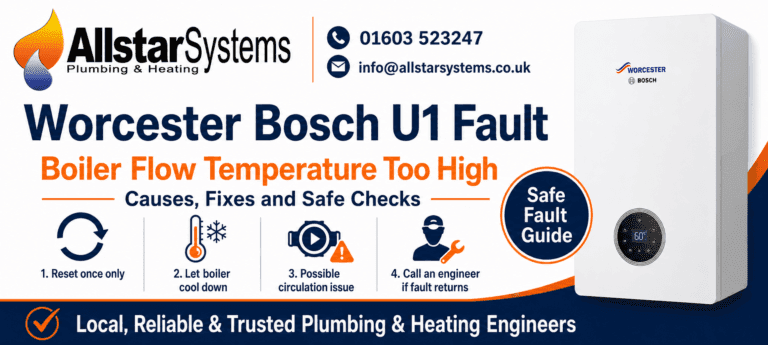
U1 means the flow temperature has risen too far.
The appliance may stop until the temperature falls. Causes can include sludge, poor circulation, pressure issues, closed radiator valves, or pump trouble.
If U1 returns, arrange a proper check.
SE usually means the boiler needs servicing.
This message may not stop the appliance right away. However, it should not be ignored.
Book a service soon, especially before colder weather.
Safe Checks Before Booking a Visit
You can make a few simple checks from outside the appliance.
First, note the exact display message. Then check whether the boiler has power.
Next, check the thermostat, timer, and programmer. Make sure they are asking for heat.
Look at the pressure gauge if your manual shows the correct range. If the gauge is low, follow the approved filling steps.
For ignition-related warnings, check whether other gas appliances work. If none work, the issue may sit with the property supply.
During cold weather, listen for gurgling sounds. If the condensate pipe is accessible and frozen, follow the manufacturer’s thawing guidance. Use warm water only. Never use boiling water.
Finally, check radiator valves. Closed valves can reduce circulation and heat output.
When One Reset Is Enough
Some Worcester Bosch manuals allow one reset.
Use the reset control only if your manual explains the process. Then wait to see whether the same warning returns.
If it comes back, stop. Repeated resets do not repair the cause. They only delay diagnosis.
When to Call a Gas Safe Engineer
Call an engineer if the warning returns after safe checks.
You should also book help if:
- the appliance keeps locking out
- heating or hot water stops
- pressure keeps falling
- fan warnings appear
- ignition warnings return
- overheating messages show
- internal errors continue
- water appears near the unit
- a carbon monoxide alarm sounds
- you smell gas
- you feel unsafe
A qualified engineer can test the parts safely and confirm the true cause.
What Not to Do
Do not remove the casing.
Do not touch gas parts, flues, wiring, fans, sensors, burners, sealed parts, or internal components.
Do not keep pressing reset.
Do not leave the filling loop open.
Do not ignore repeated pressure loss.
Also, do not follow online repair advice that involves opening the appliance.
Quick Reference Table
Display Common meaning
EA Flame not detected
A1 Pump or circulation issue
CE Low pressure
C6 Fan speed issue
C7 Fan not running
E2 Flow temperature sensor issue
E9 Safety temperature limiter triggered
D5 / d5 Condensate pump issue
F0 Internal error
F7 Flame detected when off
FA Flame detected after shut-off
Fd Reset pressed by mistake
U1 Flow temperature too high
SE Service required
Always check your own manual. Meanings can vary between Worcester Bosch models.
Need Help With a Worcester Bosch Warning?
If your Worcester Bosch boiler keeps showing a warning, do not keep resetting it.
Write down the display message, make safe external checks, and arrange a qualified visit if the issue returns.
Allstar Systems supports homeowners across Norwich and Norfolk with boiler diagnostics, repairs, servicing, and heating advice.
FAQ About Worcester Bosch Fault Codes
What do Worcester Bosch fault codes mean?
Worcester Bosch fault codes are display messages that show when the boiler detects a problem. They can relate to ignition, pressure, overheating, sensors, fans, condensate drainage, or internal components.
What is the most common Worcester Bosch fault code?
EA is one of the most searched Worcester Bosch fault codes. It often means flame not detected, which can relate to gas supply, ignition, flame sensing, or condensate problems.
What does EA mean on a Worcester Bosch boiler?
EA usually means the boiler has not detected a flame. Safe checks include gas supply, the gas meter, and a frozen condensate pipe. However, repeated EA faults need a Gas Safe engineer.
What does EA 227 mean on a Worcester boiler?
EA 227 can mean no flame detected after ignition on some models. The boiler has tried to ignite but cannot confirm a safe flame.
What does EA 229 mean on a Worcester boiler?
EA 229 can relate to flame loss during operation on some models. The boiler may light, then lose the flame signal.
What does E9 mean on a Worcester Bosch boiler?
E9 can mean the safety temperature limiter has tripped. This often points towards overheating, low pressure, poor circulation, pump faults, or system restrictions.
What does C6 mean on a Worcester Bosch boiler?
C6 can relate to fan speed. Since fan and flue operation affect safe combustion, this fault needs a qualified engineer.
Can I reset a Worcester Bosch boiler fault code?
You can reset the boiler once if your manual allows it. However, if the same fault returns, stop resetting and arrange professional diagnosis.
Can low pressure cause Worcester boiler fault codes?
Yes, low pressure can cause some Worcester boiler faults. It can also contribute to poor circulation and overheating.
Can a frozen condensate pipe cause a Worcester fault code?
Yes. Worcester Bosch says a frozen condensate pipe can cause gurgling and may show an EA error code. This often happens during very cold weather.
Are Worcester Bosch fault codes dangerous?
The code itself helps protect the boiler. However, repeated faults involving gas, flame, overheating, fans, or flues need professional attention.
How much does it cost to fix a Worcester Bosch fault code?
The cost depends on the cause. A simple pressure or condensate issue may cost less, while fan, pump, sensor, gas valve, heat exchanger, or PCB repairs may cost more.